How Dogs Learn – Part 2

September 5, 2008 by  
Filed under Featured Dog Training, Obedience Training

In Part I of “How Dogs Learn”, I touched on 2 major ways in which dogs learn new things about their environment. Through learned associations and the realization that their actions really do have consequences (both good and bad), dogs are able to make reasonable assumptions about environmental events, decide whether those events are favorable or not, and then learn how to make those events occur more often, less often, or not all.

In this section, I will talk about the different stages of learning and how you can apply them, along with the information discussed in Part I, to get the most out of all of your training situations.

The reason we think in terms of training, or learning in stages is because, in order to train a dog to perform some act or series of acts reliably and consistenly,  it’s usually easier to break the learning or training process down into smaller, more manageable pieces. This will help make even the most daunting task or training situation seem almost like child’s play. It will also allow for many more confidence-building opportunities along the way.

The stages serve as a training framework; so the training can progress logically from less-complex to more-complex concepts to allow the dog to succeed many times during the process.

The four steps, or stages that we’ll use are the following:

  1. Acquisition Stage
  2. Automatic Stage
  3. Generalization Stage
  4. Maintenance Stage
Acquisition Stage

You can think of the Acquistion stage as the entry point into the learning process. This is where the dog first becomes exposed to a learning or training opportunity. This is also where the dog first learns that certain activities are either rewarding or not rewarding.

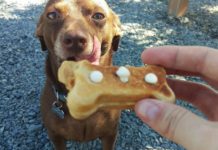
For example, if we are training our dog to Sit upon hearing the word “Sit”, the Acquistion stage is where we would first show the dog what the act of “sitting” is and why he should do it. A very basic way to begin the process would be to bait a nice tasty treat in our hand and slowly begin to move it up and over the dog’s head. The goal in moving the treat over the dog’s head is that, as he is looking up at the treat, he’ll will then place his back-end on the ground, and sit to look at it. At that precise moment, we would reward the dog (tasty treat, petting, play, etc…) for doing so.

At first, the dog may not fully understand what you are trying to get him to do and may look at you with a blank stare, as if to say, “Ok, what am I supposed to do with that?”. However, after he’s been exposed to the exercise a few times, he’ll soon pick-up on what he needs to do, and realize that by doing so, he’ll recieve a nice tasty reward. This is the beginning of the learning process.

Through this exercise, the dog learns an important association between seeing the baited hand, the act of sitting to follow the hand, and ultimately receiving a reward for doing so. He has also learned another important lesson in that, by performing the “sitting” action, he has the ability to make good things happen. This will be the dog’s motiviation to perform the operation again when he sees similar circumstances in the future.

Automatic Stage

The Automatic stage is where the dog really starts to put the repetition of previously trained sessions or general environmental occurences together, and the “lightbulb” first goes off in his head. This is where he really begins to see the relationship, or association between different things that may be happening to him, and around him, and he then starts to “learn” what he needs to do in response to those things.

During this stage, he is becoming more and more alert to what he’s been seeing and/or hearing, and proficient in knowing what he needs to do about those things, when he sees or hears them.

So, going back to our training example, within the Automatic stage, the dog is really beginning to pick-up on what we’re trying to get him to do. He’s recognizing and responding to the hand movement easily, and offering the “Sit” behavior, fairly quickly. He may even begin to “Sit” well before the luring movement is completed. At this stage, we would also be able to begin adding the word “Sit” to luring movement.

The dog would then begin to associate the word “Sit” with the hand movement. Finally, we would remove the food lure altogether, and rely solely on the verbal “Sit” cue to get the dog to offer the sitting behavior. During all of these different exercises, we would be progressing the dog through the Automatic stage of learning.

Generalization Stage

The Generalization stage really just adds upon, or broadens the scope of the Automatic stage. In this stage, the dog applies what he has learned to a variety of different situations or circumstances.

In returning to our training example at this point the dog has become fairly proficient in hearing the verbal cue “Sit” and responding according in a few areas within his home. However, upon hearing the cue in other locations, the backyard perhaps, or possibly the petstore, his proficiency and reliability become very poor or even nonexistent. The goal now is to get the dog to respond reliably to the “Sit” cue in those two locations, as well as in any other location or situation he may be faced with.

This is generally accomplished by training the dog within the contexts of those new locations and making it easy for him to learn by taking a few steps back in the training process and teaching him the basics once again. If you want your dog to perform in a certain way in a certain environment or situtation, you’ll need to train him specifically in those places. You’ll also need to add the element of training him though various types of distractions, so that, no matter he’s faced with, he’ll be able to focus on you and respond to your cues.

Maintenance Stage

Finally, the Maintenance stage is reached when the dog has a thorough understanding of a particular learned behavior, and can apply that behavior in a variety of different situations with a high degree of reliability. The new, learned behavior has become second nature to the dog. At this stage, intermittent training is still required to maintain that level of generalization and reliability. Training is a lifelong committment. Depending on the dog, only a small amount of occasional training is all that may be needed. Other dogs may need some “refresher” exercises from previous stages to help maintain a high degree of learned knowledge.

To summarize, in thinking about how dogs learn and how to go about training them, it’s often helpful to think in terms of training in a series of stages. These stages aren’t ridgidly meant to be concrete boundaries that the dog must, without flaw, complete or pass before moving on to the next stage. They are to be used as a training framework to help organize your training efforts, and break them up into smaller, more manageable pieces. This will allow you to develop a more structured training plan, which will be easier for your dog to understand and follow, be more efficient, and allow you both to have more fun in the process.

How Dogs Learn – Part 1

September 5, 2008 by  
Filed under Featured, Obedience Training

Watching a well-trained dog listen to his owner, and do exactly as he is instructed, is often a thing of amazement and wonder to those, who either are not dog owners, or are shall we say, owners of dogs that are somewhat “instructionally-challenged”.

Upon viewing the “trained” dog in action, the questions or comments that usually follow are, “how did you get him to do that”, or “I tried that, but my dog just won’t listen”, or “he just doesn’t understand  what I’m asking him to do”, or a myriad of other partially-frustrated sounding responses.

The general reply to each of those comments is, dogs learn new things in two very basic ways. Although there are a number of behavioral processes at work behind the scenes with each of them, the manner in which dogs are able to learn new concepts and behaviors, ultimately can be grouped into two forms of learning. Those two forms are Classical or Associative Learning (Conditioning), and Operant or Instrumental Learning (Conditioning) .

Associative Learning

Now what does all that mean?  Basically, Associative (Classical) learning is where, as the name implies, the dog learns to match or associate different items or events in his environment with other items or events. The dog learns that when one event happens, another one, most likely will occur. For instance, after a certain number of times your dog hears the doorbell ring, he learns, or associates the ringing of the doorbell with the presence of a person being on the other side of the door, and reacts accordingly.

His reaction, positive or negative, will depend on how your dog views vistors. The point is, that the dog has associated the sound of the doorbell to either something he really enjoys, or something he really dislikes.  Through association, the ringing of the doorbell now means something else is about to occur and his natural reactions will then take over.

Although this is a very simple example, it shows how animals learn to predict things in their environment. They learn to respond to one event (hearing the doorbell) in anticipation of a second event (greeting a guest). This is also how dogs learn to associate a spoken word, Sit, Come, Stay, etc. with a particular activity. Each of these words is paired, or ”associated” with a particular activity that the dog learns to perform.

For instance, dogs have no idea what the actual definition of the word Sit means. However, since the word sit has been paired with some activity (through training), when they hear it, they should tuck both back legs underneath them and place their back-end on the ground.

This is so, because they’ve associated the word Sit with the act of sitting. However, you could have associated any word to the act of sitting and it would work the same way. As long as the act of showing the dog how to sit is paired with a completely unrelated word, the new word would now mean Sit, and the dog wouldn’t know any different. Dogs don’t understand our language. What he has learned is that by hearing a specific word, or seeing a specific event, he should perform some act.

Now, why you ask, does the dog actually WANT to act upon the activities that he has “paired” together? The answer to that question, which is basically the underlying impetus for any form of dog training, and which also dovetails right into the second form of learning, Instrumental Learning, is MOTIVATION.

Instrumental Learning

Without motivation, there is no incentive to perform learned behaviors. If a dog isn’t motivated to perform a certain activity, he just won’t, plain and simple. Dogs do what works and in the art of training dogs, it is every dog trainer’s job to find out what motivates a particular dog to get him to perform desired activities. Motivation is where Instrumental Learning begins.

Instrumental (Operant) learning is where the dog learns that his behavior has consequences. He learns, that his actions actually have meaning and can dictate what happens to him in his environment. Sometimes his actions get him the things he really likes or needs (positive), or they can backfire and can get him things he really dislikes and/or could do without (negative).

For example, if your dog happens to go to where his favorite goodies are stored, barks and is then rewarded with a cookie, he has learned that, by performing some action (barking), he has received a very positive end result (gets cookie). The dog has now learned that his behavior can influence what happens to him, and in this case, he will be very motivated to keep repeating it. Remember, dogs are extremely intelligent, and they do what works for them.

Always be mindful what actions you are rewarding. You may wind-up rewarding things that you could regret later on. It’s the motivation factor that provides the energy for the dog to perform a particular action to get that anticipated end result. This is how we get dogs to perform the behaviors we desire.

To summarize, Associative learning is where dogs form predictions, or associations between different things or events in their environment. Instrumental learning is the process by which dogs determine on their own, that by performing some type of activity, they can control what happens to them.

Both forms of learning are used in dog training to teach dogs new behaviors, and both can have positive or negative effects on dog behavior. For a continuation on this topic, please see Part 2 of “How Dogs Learn”.