Close Encounters of the Aggressive Kind – Part 2

October 22, 2008 by Paul  
Filed under Dog Safety

Aggressive Encounters – Review of Part 1

In Part 1 of our series on aggressive dog encounters, we discussed several different safety protocols to follow in order to help keep yourself and your loved ones safe from possible aggressive or fear-related attacks by dogs you may not know very well, or not know at all. The main points to remember during an encounter with a stressed or potentially dangerous dog, are to remain as calm as possible, and try to diffuse the situation to the best of your ability.

Do not run away from the dog!

This will most likely invoke a chase response from the dog, and one in which you are likely to lose.

By learning and following the points discussed in Part 1, you’ll be better equipped to prevent potential attacks, and limit the amount of damaged sustained, should an attack occur.

Approaching Aggressive Dogs

In this section, we will discuss the topic of properly greeting and handling known dogs that have had a history of aggressive tendencies. Treatment plans for modifying aggressive behavior will not be discussed in this article.

The main talking points will revolve around safety information to better handle or prevent aggressive encounters, either to yourself or to friends and/or family members by dogs you are very familiar with. For articles regarding treatment plans for the modification of behavior problems concerning various types of aggression, please search our website for more information.

The first thing owners of aggressive, or potentially aggressive dogs must do is set the dog up for success at all times. What this means is that owners of these types of dogs must refrain from any activities that are known to provoke an aggression response in the dog.

If the dog is reactive towards house guests, then the dog must be removed and prohibited from any areas guests may enter during their visits. Rooms or locations where the dog is being held must locked to prevent accidental escapes.

If you read our article on Canine Behavior Problem Solving, you learned about environmental triggers and their effect on behavior problems. Do your best to eliminate or reduce potential aggression-invoking triggers and properly manage the dog’s environment to help him avoid all dangerous situations.

If you are unable to remove the possible problem triggers from the dog’s environment, then the dog must be removed from the environment for the time being, until all potential triggers are no longer present.

Ensure that you are doing your best not to reward/encourage inappropriate or aggressive behavior. In other words, don’t fuel the fire. If you know that your dog becomes aggressive with certain types of toys, or when he is allowed to engage in certain activities, then those toys must be removed from the dog.

Also, all activities that encourage or foster aggressive behavior must be abruptly stopped until the dog has learned to release any and all “problem” toys or learned to stop all problematic activities upon owner request.

If the dog reacts unfavorably to being removed from a certain chair or section of the house, actions must be taken to prohibit the dog from gaining access to these “very valuable resources” until the dog has learned to move from them when requested.

Common sense and sound judgement is crucial when learning to handle potentially dangerous dog interactions. Under no circumstance must you place yourself, or anyone else in harm’s way when trying to handle your pet’s aggression. Always err on the side of caution.

One of the mistakes most owners will often make during their everyday interactions with a reactive or aggressive dog, is not portraying a positive, calm and confident attitude around the dog. Sound leadership skills and being able to convey those leadership skills to your dog, showing him that you have things confidently in order, will help him understand his role in the home. Not being able to communicate these skills to your dog can reduce the chances of you being able to change his or her behavior.

Dogs are masters at reading body language, whether it be human’s or another animal’s. Dogs do what works and they have an uncanny ability to read the uncertainties in the way we present ourselves and use those uncertainties to their advantage to get the most out of a given situation.

The fact that dogs use this information for their benefit has nothing to do with being sneaky or deceitful. It has to do with learning how to survive by reading their environment to obtain the things they require and escape from the things that may do them harm. Through many, many generations of evolution, dogs have learned to take what their environment gives them to aid them in those two life-preserving necessities.

As mentioned above, owners must do their best not to encourage, enable or permit their dog to engage in inappropriate behavior. This does NOT mean that the dog must be physically abused or punished in order to prevent him from behaving inappropriately. Doing so can have serious consequences.

The main point to take away here is that the more a dog is allowed to perform a certain behavior that it deems rewarding, the better it becomes at doing it, and the more apt it is to continue it in the future. Prevention is crucial any behavior modification program.

Aggression Handling Challenges

Owner’s whom have dogs that aggressively challenge, or threaten them in any way, which include acting aggressively to obedience commands (down, sit, etc..), or aggressively defending treasured resources (food, toys, couch, etc.), should take note of the safety protocols discussed in Part 1, and try to diffuse the situation to the best of their abilities.

Do not fight fire with fire! Doing so can cause a few moments of frustration to turn into much worse. The owner should very calmly, with voice commands try get the dog to relax. Again, this is only if the dog does not respond to those vocal signals with even more aggression.

If the owner cannot calm the dog down, the best thing to do in that situation, would just be to turn away from the dog and ignore him. If the aggression is due to something the dog is possessive over, once the dog relinquishes the object or area, as mentioned above, he must not have access to it again, until he can safety release the object on command. 

If the dog is acting aggressively out of demands for a particular resource (barking, growling, etc. to obtain something he doesn’t already have) do not give in to the dog’s demands and reward him for his improper behavior by giving him what he wants. Doing so will only teach the dog that acting inappropriately is a sure-fire way for him to get whatever he desires. Don’t let the dog manipulate the situation.

If the dog wants something, then he should learn to perform a proper behavior in order to get that object. It’s give and take. He should be made to sit or lie down before getting his nightly food or before being allowed to go outside. The dog should realize that you hold the keys to him obtaining the things he needs, and the only way to get those things is to behave properly.

If owners are consistent and steadfast in their handling efforts, most dogs will ultimately defer to the owner’s requests at some point. Each dog will vary in the amount of time it takes them to learn how to properly get the resources they are looking for.

If, in the worst possible scenario, the dog bites someone, the safety protocols discussed in Part 1 must be followed. Do not try to pry the part of the body that has been attacked from the dog, and do not struggle with the dog.  Go limp and do not add any resistance to the dog’s grip. Also, do not challenge the dog. Once he has loosened his grip, the person whom was attacked should quietly move away from the dog and seek medical attention.

Although anger is a normal reaction after being the victim of a dog bite, the person being attacked must not engage in any retribution-seeking activities by physically punishing the dog. This can only make matters worse.

Final Thoughts

In learning how to handle or deal with aggressive dog situations, the most important things to take away are to try stay as calm as possible and think with a clear mind, do not do anything to incite an attack, and always use your best judgement and common-sense in every situation. You need to judge every situation and determine what the most viable course of action may be, while at the same time, trying to be as mindful as possible to the safety protocols discussed in this article.

There are occasions, however; where drastic situations will call for drastic measures, which will require you to abandon some or all of the practices discussed here. If a dog has grabbed-hold of a child, then your first priority is to get that child away from dog without risking further injury to the child. Again, every situation will be different, and if faced with a life or death situation, there are times where drastic measures are all that one has to prevent or stop a fatal attack.

If you are currently dealing with an aggressive dog and are, in any way, uncomfortable or fearful to work with your dog in any of the manners described throughout either part of this article, please consult a qualified animal behaviorist and/or your veterinarian immediately. Aggressive dogs must be handled properly, and under no circumstances are you to place yourself, or anyone else at risk when dealing with these types of dogs.


Close Encounters of the Aggressive Kind – Part 1

October 22, 2008 by Paul  
Filed under Dog Safety

Being confronted by a large, unfamiliar dog, whether it’s the neighborhood “Houdini” whom manages to pull a vanishing act on his owners from time to time, a friend or family member’s new “home-guardian”, or that massive barking ball-of-fur standing in between you and your dog’s new chew toy at the local pet store, can be somewhat unsettling. In fact, depending on the dog and the situation, it can be downright scary.

Thankfully though, most interactions with stray or unknown dogs usually pass by without incident and actually are very friendly. There are those rare cases however, that can really bring about some very anxious moments of uncertainty, and/or pose a significant risk to yourself, and anyone or anything that may be with you.

The keys in preventing a serious attack are being able to read and understand the various signals the offending dog may be sending your way, and knowing which behaviors, on your part, can either provoke or prevent an attack. Being able to react properly can also help minimize the damage sustained if an attack somehow cannot be prevented.

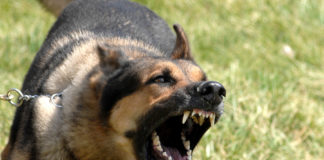
Typical body positions or gestures for dogs that may be on the brink of attack can include, but are not limited to wide, firm, forward-looking body stances, barking and/or growling, pupil dilation, hackles raised (hair on neck and tail), ears erect and possible tail raising or wagging. It’s important to note that each dog will have it’s own unique characteristics for handling stressful or perceived threatening situations, and may not show all of the signs listed above.

Many people make the assumption that if a dog is wagging it’s tail, it’s indicating that he or she is friendly or means no harm. This is not always the case. Dogs carry their tails in many different ways for a variety of different reasons, and not all of them indicate friendship or lack of a cause for concern. A dog’s tail wagging is indicating that he is ready to act in some way, and it may or may not be friendly. For more explanations and visual interpretations of canine body language and aggression, check out our article on Watching Your Dog for Signs of Stress.

The first section of this article will discuss the proper protocols to follow when confronted by dogs whom you may be completely unfamiliar with, as well as those you may have seen before, however; have virtually no knowledge about. In part II, we’ll discuss how best to interact with those dogs you are very familiar with and consider trustworthy.

An Imperfect Stranger

Dogs that are unknown present the biggest set of challenges when it comes to human confrontation. These issues stem from little or no knowledge of the dog’s temperament, mental or physical condition, and also, prior vaccination record. Stray dogs pose the greatest amount risk for this category due to the complete lack of historical data concerning previous aggression issues and communicable diseases.

Therefore; it’s vitally important to proceed with caution with any stray or free-ranging dog, and to be mindful of the following points to help minimize the chances of being attacked.

Do Not’s
  • Do not fight fire with fire. Acting aggressively towards a reactive dog is likely only to incite an attack. Yelling, screaming, stomping feet, throwing objects, or antagonizing the dog in any way may cause a bad situation to get much worse by intensifying the dog’s aggression. Also be mindful of young children who may be fearful of large or unknown dogs and scream out of fear. The high pitches of a young child’s screeching may cause an aggressive dog to attack due to effects of being frightened by the sound.
  • Do not stare the dog down directly or make persistent eye contact. Dogs can interpret eye contact as being threatening, which may provoke an already aggressive or frightened dog to attack.
  • Do not square-off against a fearful or aggressive dog. This may be interpreted as an offensive position and could intensify the dog’s anger or fear. When greeting a strange dog, try to stand slightly to the side but always be mindful (without direct eye contact) of the dog’s position. By standing at a slight angle to the dog, you are sending him somewhat of a calming signal which indicates that you mean him no harm. Avoid abrupt movements.
  • Avoid aggressively petting or wrestling when greeting unfamiliar dogs. Also never place your face near a strange dog’s mouth. Young children should especially be made to abide by these rules. They should also be taught to never place their face near the mouth of any dog, be it known or unknown.
  • If possible, avoid approaching nervous, frightened or aggressive dogs. If you must approach, do so calmly and slowly and avoid approaching directly from the front, or from behind. Try to approach using an arc-like movement. Quick, deliberate movements directly toward dogs that are unsure of themselves can be viewed as threatening and make it appear as if they are about to be attacked. By moving in a slow, calm, arcing movement, the appearance of a possible threat is minimized.
  • Do not run. This will more than likely trigger a chase response in the dog, and one in which the dog is likely to catch you. Unless you are 100% positive, beyond the shadow of a doubt, absolutely sure that you can make it to a safe location within a few steps, you must never, never run from a dog that has approached you. By doing so, you will also have to take your eyes off the dog. This is never a good idea.
  • Never corner a fearful, nervous or agitated dog. By taking away all of dog’s options to escape from a stressful or frightening situation, it may feel it has no other chance for safety but to attack and defend itself. Dogs that are frightened or nervous should be left alone. This is especially true for young children.
  • Do not tease a strange dog under any circumstance. This is especially true with food or toys.
Do’s
  • Always ask the owner (if one is present) if it’s safe to pet their dog. Public encounters with unfamiliar dogs should always be initiated by obtaining the owner’s permission to greet and pet the dog. This is imperative for young children. Young children should be encouraged not to play with strange dogs unless accompanied by a responsible owner, and must be taught to always ask permission before greeting any strange animal.
  • Be mindful of a dog’s territory. Dog’s may become extremely defensive of their belongings and territory. If you encounter a strange dog, whom you know may be defending his or her home property, always proceed with caution. Try to walk another route or, if you must pass through the dog’s territory, do not do anything to incite further aggression. See item 1 in the DO NOT section above.
  • Always be mindful of a strange dog’s location relative to yourself, especially those that seem aggressive or worrisome, by watching his movements and positions without making direct eye contact. Monitor the dog by using the corner of your eyes or looking at him without looking directly into his face or eyes.
  • Try to stand tall but do not tower over dog. Keep arms and hands down low by your side and keep your movements slow and smooth.
  • If approached by a dog that seems dangerous, backup slowly without turning your back on the dog and as stated in number 3 above, always be mindful of the dog’s location and possible intentions. Talk calmly and smoothly to the dog only if it seems as if it may be helping the situation. If the dog intensifies in fear or anger, stop all communication. Move slowly and directly to a safe location. Avoid running or making abrupt movements.
  • Always be mindful of your actions. Pet and greet strange dogs (with owner’s permission) in smooth, calm movements. Ask the owner if there are any areas the dog does and does not like to be touched and always obey the owner’s instructions.
  • Young children should always refrain from touching or playing with dogs while the dog is eating or playing with a toy. This goes as well for when the dog is sleeping, nervous, frightened, isn’t feeling well due to an illness or being overexerted from the heat or strenuous activities.
  • When greeting a dog, just keep your hands down by your side and let him sniff the back of your hand. Let the dog approach on his terms. Always be mindful of the owner’s instructions for petting. See number 6 above. Avoid petting or patting the top of the dog’s head. Unless otherwise instructed, pet the dog under the chin or on the belly and try to pet in the direction the fur is going.

    The dog will appreciate that much more than a few pats on the head. Always be mindful to keep your face or those of your children away from the dog’s mouth while petting him. Refrain from petting strange dogs that are fearful or are unsure of themselves.

What to Do if Attacked
  • Do not incite further aggression by yelling or screaming. This may make matters worse. Remain silent and as calm as possible.
  • Do not pull away from a dog that has bitten you. This is always very difficult to practice, because the first reaction is to try and pry, whichever part of the body the dog has bitten, loose from his mouth. Doing so can cause severe damage to that area, because the dog’s initial reaction is to tighten his jaws and pull in the opposite direction. The majority of damage sustained in dog bites is caused from trying to pull free of the dog’s bite.
  • As difficult as it may be, try to remain as calm as possible. When the dog releases grip, try to follow all the points mentioned above to try to get away, as well the following.
  • If escape is not possible, fall quietly to the ground, and, using your arms and hands, curl up into a ball to protect your head and face. You can also perform this procedure if you had fallen in the process of escaping from a threatening dog. Young children should become especially familiar with this position in the event they are attacked.
  • If a child is attacked, the same rules apply with regards to trying to wrestle the child away from the dog. This is where the majority of damage can be caused. In this case, you need to resort additional measures to get the child to safety. Previous rules discussed here may need to be ignored. You need to get the dog’s attention away from the child; therefore, look for whatever you have at your disposal to accomplish this. If you have something you are able to throw over the dog or wrap around him, use it. If you are able to wet the dog with a hose or pale of water, do so. Remain quiet and calm in the process and instruct the child to assume the position described above. Do whatever you can to distract the dog and get the child to safety, without getting into a battle of strength with the dog.

Above all, the best advice to give when either approaching or being approached by an unfamiliar or worrisome dog is to use common-sense. If your instincts tell you that the dog isn’t to be trusted, then chances are, that’s what you should base all your decisions on, whether the owner tells you the dog is friendly or not.

Always be mindful of young children and strange dogs. Before even asking whether or not a strange dog is friendly, perform your own assessment.

  • How does the dog look?
  • Does he appear nervous?
  • Does he appear to be stressed, possibly from an illness or from some other external factor?
  • Is he barking or growling or doing anything else that makes you feel uncomfortable?

Once you’ve done your own external evaluation and feel the dog is approachable, always ask the owner’s permission, and again decide for yourself if the dog is friendly or not. Children should never be forced to approach or pet a dog if they’re reluctant or scared.

Be mindful of the points discussed in this article and you’ll be better equipped to handle those rare and unfortunate encounters with a much more confident outlook. For more on handling and dealing with known or familiar dogs, see Close Encounters of the Aggressive Kind – Part 2.