Teaching Your Dog to Take Food Gently

October 31, 2008 by Paul  
Filed under Obedience Training

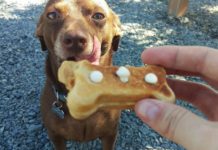
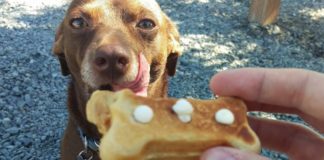
Taking food gently out of your hand is a skill all dogs should learn. For many dogs, taking a portion of their owner’s finger, along with a morsel of food, is a sure-fire way to make sure they actually get the treat from owners whom make a habit of pulling their hands away as soon as they feel the dog’s mouth on their skin.

Other dogs that exhibit overly-grabby behaviors are merely overly-excited about receiving a treat anyway they can get it.  In each of these cases, these dogs have either picked-up some bad habits, as a result of some improper training on the part of their owners, and/or really haven’t been properly taught how to take food from their owner in the first place.

Your job as a dog owner is to show your dog the correct way to get the things he desires in life.

Option 1

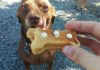
Feed your dog small morsels of food from your hand, but try not to remove your fingers from the food. Keep them tight on the food so the dog is always in contact with them.

If he’s a little nippy, and your first instinct is to move your hand away, DON’T!! Keep your hand there and wait until he’s figured out that he doesn’t get the treat until the nipping stops. Once the light bulb goes off, and he’s calm, reward him.

Any type of misbehavior, i.e., barking, pawing, etc. just results in the delay of him receiving his treat. Remain quiet and still, and wait him out. Hang on tight until he eases his mouth, then release the food, and give him some nice praise for doing such a great job. This teaches bite inhibition as well. If his teeth are really causing you a lot of pain, you can try this with gloves on or try Option 2.

Option 2

If, after practicing with Option 1, your dog is still nipping you when you feed him from your hand or you just cannot tolerate his nipping, give this option a try.

Put a treat in your hand (referred to as “baiting your hand”) and hold it approximately at your eye level. Ask him to sit and slowly bring your baited hand down towards his mouth. If he remains seated and attempts to take the treat gently, say “Yes” or “Good” and give him the treat. 

If the dog has learned to respond to Clicker Training, you can always reinforce his positive behavior with the clicker as well. If he jumps out of the sit or goes to lunge for your hand with his mouth, just say “Ahh-Ahh”, and abruptly pull the treat away back up to your eye level.

Try the exercise again.  Keep practicing this exercise of lowering and pulling away as needed, until your dog has learned the proper way to get his rewards.

Puppy Nipping

September 7, 2008 by Paul  
Filed under Behavior Problems, Featured Puppies, Puppy Training

No Nipping Allowed!
Teaching Your Dog Proper Play Etiquette

Introduction to Puppy Nipping

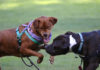
Puppy nipping is a very common problem for new puppy owners. It is also one that can be very frustrating (and painful) to deal with. If not dealt with correctly, it can become a serious problem later in the dog’s life. Typically, puppies engage in nipping behaviors during excitable greetings or playtime. This usually occurs in pups less than 5 months of age.

Puppies are like human babies when it comes to exploring their environment. They do so by touching and tasting everything. Since puppies don’t have hands, they use their mouths to do their exploring.

Puppy nipping is a form of social play between puppies and dogs. Puppies and dogs interact with each other by mouthing and pawing each other. This teaches puppies some very important lessons about acceptable and unacceptable behavior when it comes to using their mouths and teeth. They learn how to inhibit their bite strength in order to remain socially acceptable.

Since our skin is much more sensitive than a dog’s fur-covered skin, they must learn that nipping and pawing are not acceptable forms of interacting with us. They need to be taught other positive ways to greet, socialize and play with their humans.

Nipping the Problem in the Bud

In order to teach your puppy the proper way to interact with you, you’ll need to show him that good things happen when he plays nicely with you and doesn’t nip. If he nips, he loses his playmate and in the process, he learns it also has other drawbacks. The basic principle here is, he gets lots of praise and petting as long as he doesn’t nip. If he nips, we show him how much we don’t appreciate it, and all play stops.

11 Helpful Tips

  1. Try to pet your pup at times when he is calm/quiet or preoccupied chewing a toy. Make sure the dog has plenty of “legal” toys that he can chew on and be prepared with at least two or three of these toys before you begin playing with your dog. Keep switching toys and keep the dog fixated on the toys.
  2. Have “special” play toys that are brought out only at playtime. This keeps them new and interesting to the puppy. When you are done playing, put the toys away. Keep items such as socks, shoes, remote controls, etc… out of you puppy’s reach when playing.
  3. If you can, have “special” play areas in the house where you will typically play with your puppy. If possible, try to keep these areas separate from the ones you normally use to relax, watch TV, read or just have quiet time. Using these areas to play with your puppy might set him up to fail because the puppy will not understand that you want your “quiet time” in these places.
  4. While he is chewing on his toys, give him lots of praise and petting. Let him know how much you like it when he chews on these toys instead of your skin.
  5. If he gets bored with his toys and starts nipping on your skin or clothes, scream “OW”, “OUCH” or whichever word you’d like, immediately stop playing with him and ignore the dog for a couple of seconds.This will let him know his nipping really hurts and his fun is being put on hold. Try to be slightly over dramatic with this step; however, don’t frighten the dog. The object is to startle him, make him let go and possibly back away from you. You don’t want to cause a fear response. The dog should left wondering “what the heck was that?
    • After a second or two, resume playing and pet and praise as long as he doesn’t nip. If he starts nipping, repeat the process. If after 2 or 3 times, the technique doesn’t noticeably decrease the nipping, just walk away from the puppy. Don’t have any interaction. If you need to, leave the room altogether.
    • Be consistent with this technique every time he begins to nip. Everybody whom comes into contact with the puppy should practice this same technique.
  6. Another technique you can try, which is similar to Step 3; however, instead of screaming “OW, OUCH, etc…” try immediately freezing the instant he puts his open mouth on your skin. This is called shunning. Try not to wait until he is actually putting his teeth on your skin. Don’t pull away, flinch or jerk your hand away as the puppy might think you are playing.
    • After a second or two, resume playing and pet and praise as long as he doesn’t nip. If he starts nipping, repeat the process. If after 2 or 3 times, the technique doesn’t noticeably decrease the nipping, just walk away from the puppy. Don’t have any interaction. If you need to, leave the room altogether.
    • Be consistent with this technique every time he begins to nip. Everybody whom comes into contact with the puppy should practice this same technique.
  7. Give your dog lots of good exercise. A tired dog is a good dog and is less likely to be rambunctious and/or nip.
  8. Try coating your hands and/or feet with chewing deterrent (Bitter Apple) before you interact with your puppy.
  9. Avoid tug-of-war, wrestling, slap-wrestling or chase games. These only encourage the dog to get excited and want to nip.
    • Instead try playing constructive games that teach leadership and don’t encourage excitable, nippy interactions. If the dog knows some basic obedience cues, practice those cues in your play sessions. This will give him something positive to work towards and distracts him from wanting to nip.
  10. Instruct everyone that interacts with your dog not to encourage or allow the nipping behavior. They should greet the dog calmly by keeping hands slow and low, preferably with a toy or a treat. If you need to have a collar and a leash on your dog to restrict his nippy greetings, please do so. If he is highly excitable and nippy, use the leash to keep him away from your guests until he is visibly calmer and then try re-introducing the dog to the guest.
  11. Puppies will outgrow this behavior if you are extremely consistent in your interactions with him. Consistency is the key to success with this and all behavior problems. The more you allow nippy behavior the longer it will take him to learn not to do it.

Maintain those leadership qualities and DON’T allow your puppy to nip at all.